DeepPVMapper

Open source deep learning for remote sensing of rooftop solar systems at national scale

Mines Paris - PSL University and RTE France

Mapping Rooftop PV at National Scale

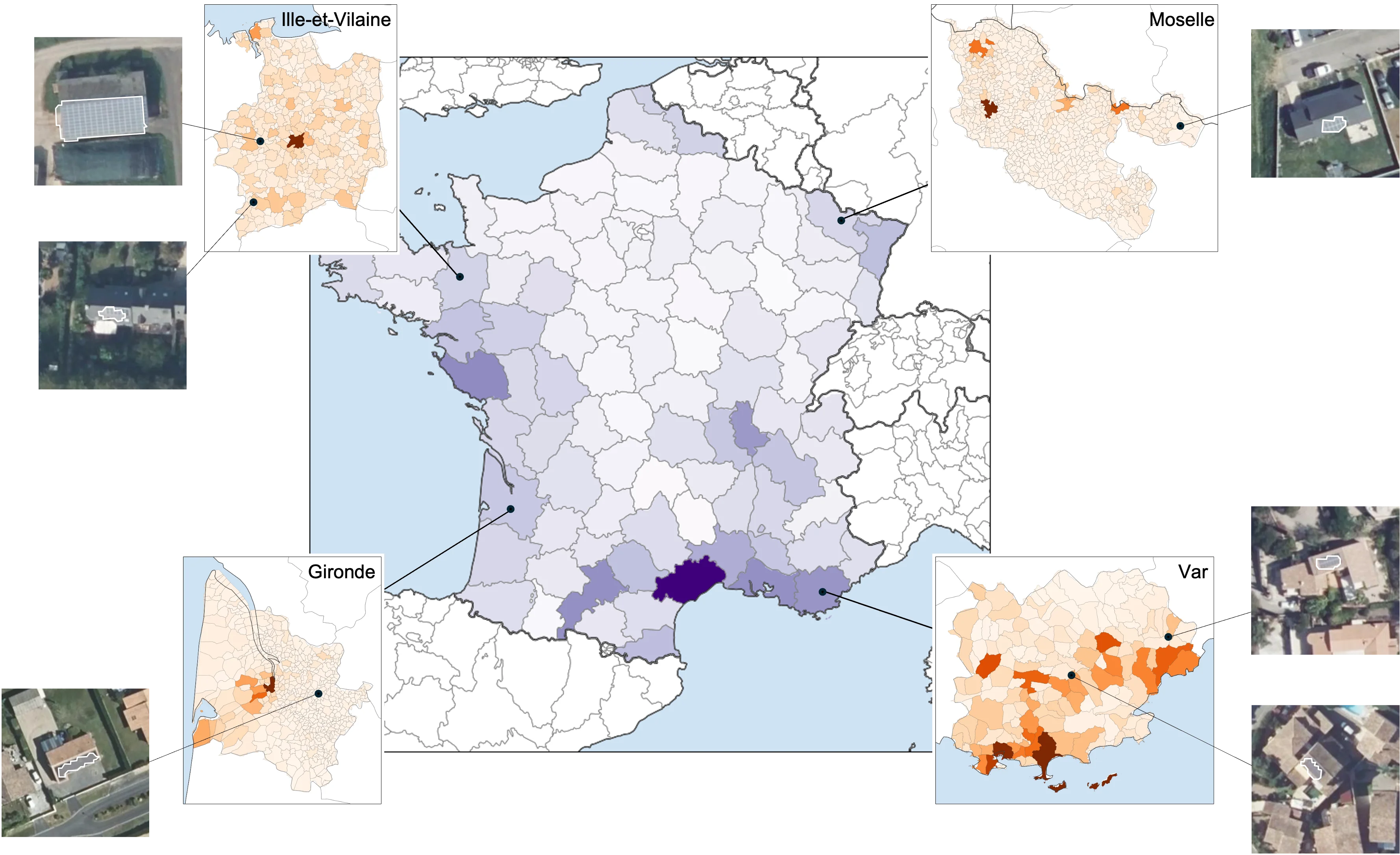
DeepPVMapper is a, open source, remote sensing-based rooftop PV mapping algorithm. It is part of a PhD project carried out at RTE, the French transmission operator. Applied across France on IGN BD ORTHO® imagery acquired between 2018 and 2024, DeepPVMapper has produced the largest registry of rooftop PV systems at this level of detail anywhere in the world. For each system, the registry reports its surface, tilt, orientation, estimated installed capacity, and precise location (latitude/longitude).

520k+ PV systems mapped
2.7 GWp Estimated installed capacity
34k Samples used for validation
DeepPVMapper mapping results
Overview of the mapping of rooftop PV systems by DeepPVMapper. The darker, the higher the installed capacity.

The Pipeline

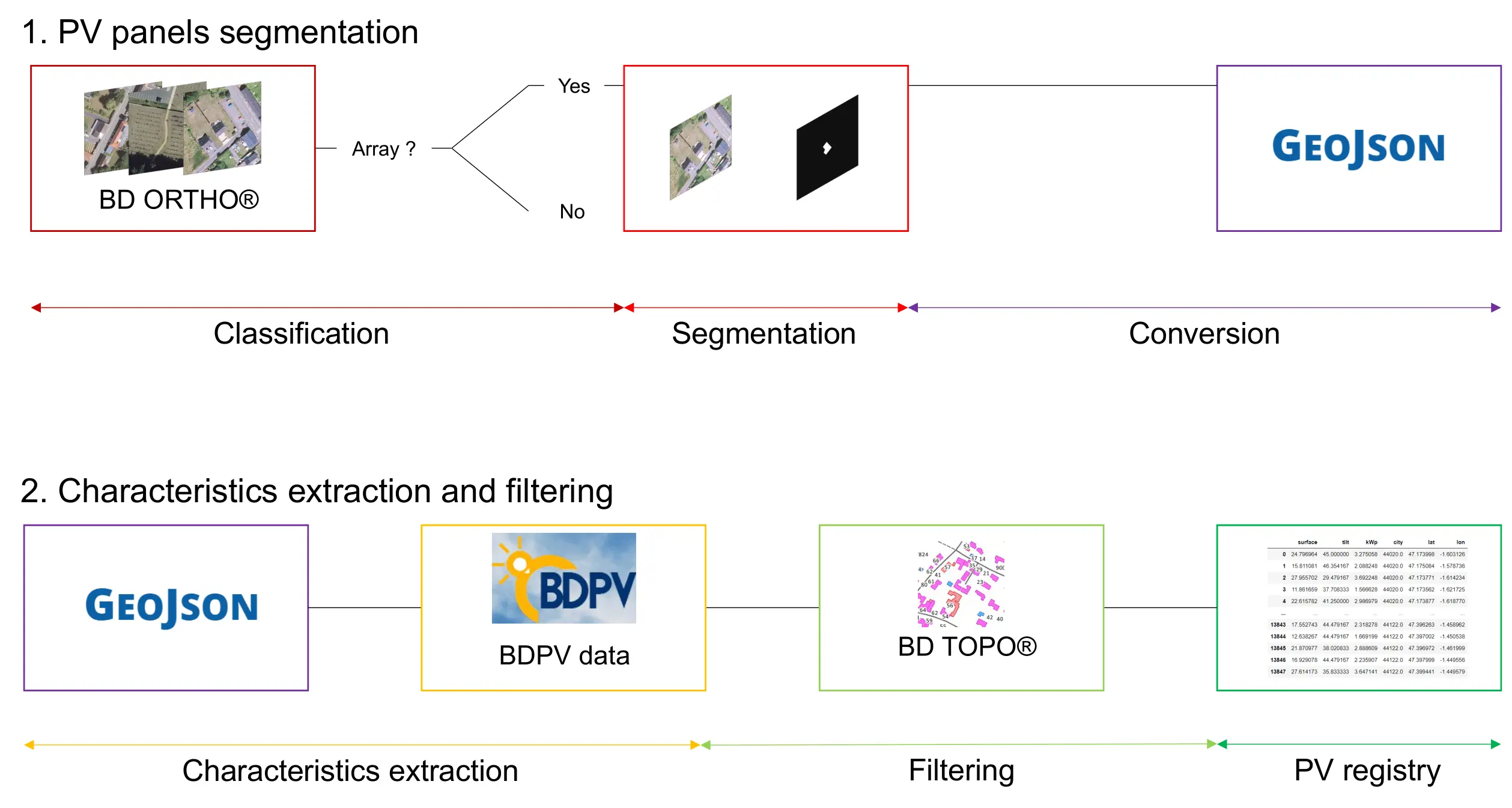
DeepPVMapper is a deep learning pipeline, inspired by 3D-PV-Locator (Meyer et al., 2022), that detects rooftop photovoltaic systems from aerial imagery and characterizes them. It proceeds in two stages: a classification model (Inception v3) flags candidate image patches, which are then segmented (DeepLab v3) to extract precise polygon boundaries. The resulting polygons are processed with pypvroof, a purpose-built package (available on PyPI) that estimates each system's characteristics — surface, tilt, orientation, and installed capacity — and cross-referenced with the BD TOPO® building database to keep only rooftop-mounted detections and merge detections belonging to the same roof. The output is a geolocated PV registry. The models are trained on BD-PV, a novel annotated dataset built on IGN's BD ORTHO® aerial imagery.

Explore the pipeline in detail →

How Reliable Are Grid-Connection Registries?

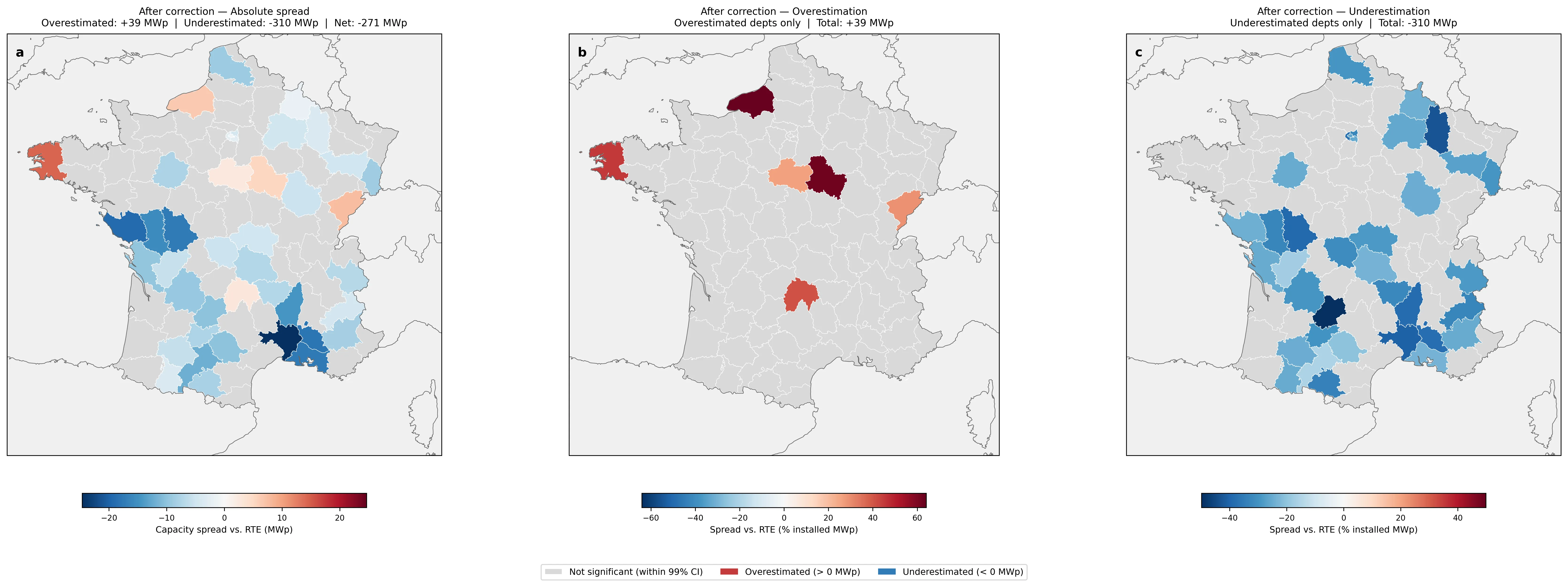
Using DeepPVMapper's detections as an independent ground truth, we estimate — after correcting for the pipeline's measured precision and recall by département — the actual distribution of installed capacity and number of systems across France, and compare these estimates to official grid-connection data (RNI/RTE) using a confidence-interval approach. The results reveal a clear and quantifiable underestimation of rooftop PV in official registries, particularly in rural areas — reversing the usual paradigm where registries serve as ground truth for remote-sensing methods, and instead using remote sensing to audit the registries themselves.

Read the full analysis →

Citation

@phdthesis{kasmi2024enhancing,
  title={Enhancing the Reliability of Deep Learning Models to Improve the Observability of French Rooftop Photovoltaic Installations},
  author={Kasmi, Gabriel},
  year={2024},
  school={Universit{\'e} Paris sciences et lettres}
}